
Home > Homematic IP > homematic IP HmIP-WTH-B-2 Wall Thermostat Installation Guide
homematic IP HmIP-WTH-B-2 Wall Thermostat Installation Guide












Troubleshooting
10.3 Duty Cycle
10 Troubleshooting
The duty cycle is a legally regulated li-
mit of the transmission time of devices
in the 868 MHz range. The aim of this
regulation is to safeguard the opera-
tion of all devices working in the 868
MHz range.
10.1 Low battery
Provided that the voltage value per-
mits it, the wall thermostat will remain
ready for operation also if the battery
voltage is low. Depending on the par-
ticular load, it may be possible to send
transmissions again repeatedly once
the batteries have been allowed a brief
recovery period.
In the 868 MHz frequency range we
use, the maximum transmission time of
any device is 1% of an hour (i.e. 36 se-
conds in an hour). Devices must cease
transmission when they reach the 1%
limit until this time restriction comes to
an end. Homematic IP devices are de-
signed and produced with 100% con-
formity to this regulation.
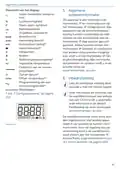
If the voltage drops too far during
transmission, the empty battery symbol
( ) and the corresponding error code
will be displayed on the device (see
„10.4 Error codes and flashing sequen-
ces“ on page 37). In this case, re-
place the empty batteries by two new
batteries (see „9 Replacing batteries“ on
page 35).
During normal operation, the duty
cycle is not usually reached. However,
repeated and radio-intensive pairing
processes mean that it may be reached
in isolated instances during start-up
or initial installation of a system. If the
duty cycle is exceeded, this is indicated
by three slow flashes of the device LED,
and may manifest itself in the device
temporarily working incorrectly. The
device starts working correctly again
after a short period (max. 1 hour).
10.2 Command not confirmed
If at least one receiver does not con-
firm a command, the device LED lights
up red at the end of the failed trans-
mission process. The failed transmis-
sion may be caused by radio inter-
ference (see „13 General information
about radio operation“ on page 39).
This may be caused by the following:
• Receiver cannot be reached.
• Receiver is unable to execute the
command (load failure, mechanical
blockade, etc.).
• Receiver is faulty.
36

| General | Details |
|---|---|
| Name | homematic IP HmIP-WTH-B-2 Wall Thermostat Installation Guide |
| Make | Homematic IP |
| Language | English |
| Filetype | PDF (Download) |
| File size | 3.71 MB |
 (1 votes, average: 5.00 out of 5)
 Loading...

homematic IP HmIP-eTRV-2 Radiator Thermostat Instruction Manual

homematic IP HmIP-BWTH-A Wall Thermostat Installation Guide

homematic IP TRV-E-A Monday Radiator Thermostat Instruction Manual

homematic IP HAP Radiator Thermostat Instruction Manual

homematic IP HmIP-eTRV-F Radiator Thermostat Instruction Manual

Homematic IP HmIP-WTH-B Wireless Wall Thermostat Instruction Manual

homematic IP HmIP-eTRV-E Series Radiator Thermostat Evo Installation Guide

Homematic IP BMOAONSUT Radiator Thermostat User Manual

homematic IP C-2 Radiator Thermostat Instruction Manual

homematic IP IP HmIP-eTRV-CL Radiator Thermostat Instruction Manual


REHAU NEA H 24 V Room Thermostat Instruction Manual

EMERSON 1F75H-21NP Non Programmable Heat Pump Thermostat Instruction Manual

resideo TH2110WF4008 Smart Thermostat User Guide

namron 4512737 Touch Zigbee 16A Thermostat Instruction Manual

seitron Wi-Time Wall Wi-Fi Programmable Thermostat Instruction Manual

LAE AC1-2W Digital Thermostat Instruction Manual

ICM CONTROLS SC2010 N-L Non Programmable Electronic Thermostat Instruction Manual

king K702E-2 SimplStat Electronic Thermostat Instruction Manual

Danfoss Heating Solutions WT-T BasicPlus2 Room Thermostat Installation Guide

micro-Air EasyTouch RV 351 Thermostat User Manual