
Home > OLIMPIA SPLENDID > OLIMPIA SPLENDID 9899 Thermostat User Manual
OLIMPIA SPLENDID 9899 Thermostat User Manual




RESET INSTALLER CONFIGURATION
In order to reset the installer configuration, so that all parameters are restored to the factory default
values, access configuration mode by pressing the
and
buttons until the message “Con”
is displayed, and then press the
and
buttons for a few seconds, until the display reverts to
the usual screen.
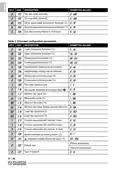
DESCRIPTION OF MAIN CONFIGURATION PARAMETERS
The main installer configuration parameters are shown in table 1 and explained below.
P01: Select system type.
2-pipe system:
when configured for a 2 pipe system, the thermostat drives a single valve at the output of the
heating valve, in both heating and cooling mode, since the same valve is used to control both hot
and cold water.
See Fig. 12a and Fig. 12b for the respective wiring diagrams.
In case of a 2 pipe system without a valve, and therefore without connections on the valve output,
for effective regulation parameters P03 and P04 should be set to “fan control”.
4-pipe system:
when configured for a 4 pipe system, the thermostat drives both valve outputs, so as to activate
eitherthehotorcoldwaterflowdependingonthecurrentrequirementsofthecontrolledenvironment.
See Fig. 12c and Fig. 12d for the respective wiring diagrams.
System with heating element:
the regulator is configured to control a system equipped with an electric heating element for heating
the room, see the section “System with heating element” for more details.
System with integrated heating element:
the regulator is configured to control a system equipped with an integrated heating resistance: see
the section “System with integrated electric heating element” for more details.
P02:Thisparameterdefineshowthecontrollerswitchesfromcooling(summer)totheheating
(winter) mode and vice versa.
Switching may be either manual or automatic:
Manual:
The user selects heating or cooling mode manually.
Automatic:
The thermostat switches automatically from the heating to cooling mode or vice-versa.
This automatic operation varies depending on the system type selected in P01.
In case of a 4 pipe systems or systems with a heating element, the thermostat operates with a neutral
zone, so that it activates heating or cooling depending on the set-point temperature.
In case of a 2 pipe systems or a systems with an integrated heating element, the thermostat executes
the changeover depending on the supply water temperature. When the supply water temperature is
low (i.e. below the threshold defined in parameter C01), the thermostat switches to cooling mode.
On the other hand, when this temperature is high (i.e. above the threshold defined in parameter
C02), the thermostat switches to heating mode.
IT - 19

| General | Details |
|---|---|
| Name | OLIMPIA SPLENDID 9899 Thermostat User Manual |
| Make | OLIMPIA SPLENDID |
| Language | English |
| Filetype | PDF (Download) |
| File size | 5.17 MB |
 (1 votes, average: 5.00 out of 5)
 Loading...


Danfoss RAS-C2 Combi Radiator Thermostat Installation Guide

GENERALLIFE MITRA 260S RF Wireless Room Thermostat User Manual

EPH Controls RFCP-RFCA RF Cylinder Thermostat Instruction Manual

SIEMENS TH 193 HC Heating and Cooling Room Thermostat Instruction Manual

Thermogroup 5255 Manual Thermostat Installation Guide

Honeywell CT31 Low Voltage Thermostat Owner’s Manual

aube technologies TH110A-DP-P Thermostat User Manual

HITACHI ATW-RTU-11 Wireless Ambient Thermostat Instruction Manual

WHITE-RODGERS 1F95-1277 Universal Thermostat Owner’s Manual

HERSCHEL T-MT Mains Powered WiFi Thermostat Instruction Manual