
Home > Robertshaw > Robertshaw RS8210 Thermostat Installation Guide
Robertshaw RS8210 Thermostat Installation Guide


RS8210
Installation Manual


| General | Details |
|---|---|
| Name | Robertshaw RS8210 Thermostat Installation Guide |
| Make | Robertshaw |
| Language | English |
| Filetype | PDF (Download) |
| File size | 0.5 MB |
 (1 votes, average: 5.00 out of 5)
 Loading...

Robertshaw RS9220 Programmable Thermostat Installation Guide

Robertshaw RS10420T WIFI Programmable Thermostat User Guide

Robertshaw RS8110 Non Programmable Thermostat Instruction Manual

Robertshaw RS8210 Non-Programmable Multi-Stage 2H-1C Wall Thermostat User Manual

Robertshaw RS9220 Digital Programmable Wall Thermostat Instruction Manual

Robertshaw 9602 Programmable Thermostat User Manual

Robertshaw RS9320T Programmable Touchscreen Wall Thermostat Instruction Manual

Robertshaw RS9423T Thermostat Installation Guide

Robertshaw RTC500 WIFI Thermostat Instruction Manual

Robertshaw RS1110 Programmable 1 Heat 1 Cool Wall Thermostat Instruction Manual
Robertshaw RS8210 Thermostat Installation Guide Overview
Summary of Contents
- Page 1: Page 1
- Page 2: Thank you for purchasing a Robertshaw thermostat. This manual will describe how to install and test the Robertshaw RS8210 thermostat. IMPORTANT SAFETY INFORMATION Always turn off power at the main power source before installing, removing, cleaning, or servicing thermostat. Read all of the information in this manual before installing or programming this thermostat. This is a 24V AC low voltage thermostat. Do not install on voltages higher than 30V AC. All wiring must conform to local and national building and electrical codes and ordinances. Do not short (jumper) across terminals on the gas valve or at the system control to test installation. This will damage the thermostat and void the warranty.
- Page 3: Install the thermostat 4 to 5 feet above the floor in an area with good air circulation and average temperature. For new installations, mount thermostat on an inside wall, 4-5 feet above the floor. Do not install the thermostat behind a door. Do not install the thermostat in a corner. Do not install the thermostat near air vents. Do not install the thermostat in direct sunlight. Do not install the thermostat with an outside wall behind it. Do not install the thermostat near any heat or steam generating fixtures. Do not install the thermostat near any concealed pipes or chimneys. Installation at these locations will affect thermostat operation.
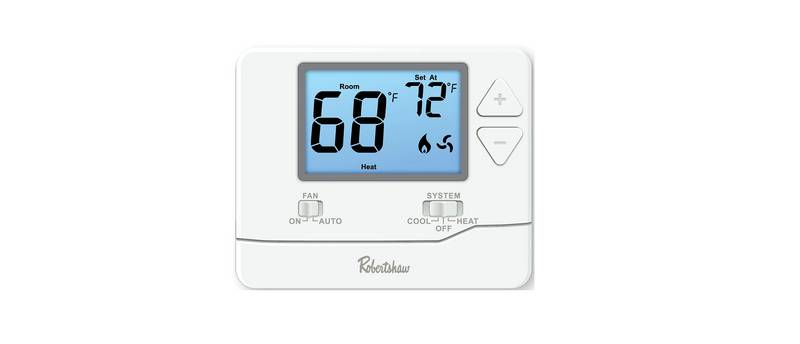
- Page 4: Getting to know your thermostat Displays the user selectable set-point temperature. Hold: Is displayed when thermostat program is overridden. Low battery indicator: Replace batteries when indicator is shown. The icon will display when the COOL, HEAT, or fan is on. If these icons are flashing, there is a 5-minute delay for compressor protection. This thermostat has 4 programmable time periods per day. Indicates the current room temperature. Temperature set-point buttons. Easy change battery door.
- Page 5: Wallplate installation This product is mercury-free. Electrical hazard Disconnect power before installing this product. Failure to do so can cause electric shock or equipment damage. If replacing a control which contains mercury, it needs to be disposed of properly. Contact your local waste management authority for instructions regarding recycling and proper disposal of the control. For a vertical mount, put screws on the top and bottom. For a horizontal mount, put screws on the left and the right.
- Page 6: Turn off power to heating/cooling system. Remove old thermostat but leave wallplate with wires attached. Do not remove wallplate.
- Page 7: Label the existing wires using the supplied wire labels as you disconnect them. Remove wallplate from the new thermostat and mount onto wall. Apply these wiring labels to each wire with the appropriate terminal designation as you remove it from the existing thermostat. Wiring labels include designations such as B, G, R, Y2, C, E, F, H, L, RH, W1, O, P, U, and others. Ensure proper labeling to facilitate correct reconnection. Separate wallplate from new thermostat before installation. Use the appropriate terminal designation for each wire. Follow the instructions carefully to avoid wiring errors. Maintain organization of wires during the installation process. Refer to the wiring labels for guidance on terminal connections.
- Page 8: Separate wallplate from new thermostat. Mount the new wallplate using the included screws and anchors. Drill 3/16-in. holes for drywall. Drill 3/16-in. holes for plaster.
- Page 9: Connect wires by matching wire labels. If labels do not match letters on the thermostat, refer to Alternate Wiring (Conventional Systems) on page 9 for proper connections. Insert wires and tighten screws.
- Page 10: Wiring Alternate wiring (conventional systems) If labels do not match letters on the thermostat, check the chart below and connect to terminal as shown. If C or X wire is available then you can connect with C terminal. If there is no C or X wire then no need to connect with C terminal. If you have a heat pump without auxiliary/backup heat connect O or B, not both. If you do not have a heat pump, do not connect B. Wrap bare end of wire with electrical tape. Place a jumper (piece of wire) between Y and W if you are using a heat pump without auxiliary/backup heat.
- Page 11: Wiring Terminal designations Heat pump system Conventional system Transformer power Reversing valve energized in heat Reversing valve energized in cool Fan relay First stage of emergency heat Installation note: Do not overtighten terminal block screws, as this can damage the terminal block.
- Page 12: Wiring Power supply. Use either O or B terminals for reversing valve. Optional 24 VAC common connection when thermostat is used in battery power mode. Jumper (not supplied). 2H/1C heat pump system. In many systems with no emergency heat a relay jumper can be used between E and W2.
- Page 13: Wiring Typical 2H/1C heat pump system with separate emergency heat This thermostat is only compatible with one transformer systems.
- Page 14: Installer setup menu for easy configuration. Follow the procedure to set up the thermostat for the specific heating/cooling system. Press MENU. Press and hold TECH SET for 3 seconds. Configure the installer options using the provided table. Use or to change settings and NEW STEP or PREV STEP to navigate options. Only press DONE when you want to exit the Installer Setup options. °F/°C selection setting: F (Fahrenheit) or C (Celsius). 24H/12H selection: Setting the 24 hour or 12 hour time format. ELEC/GAS selection: Select the ELEC or GAS.
- Page 15: Installer setup menu includes factory default settings and feature descriptions. The filter change reminder can be adjusted from OFF to 2000 hours in 50-hour increments. Press the second button from the top left side of the thermostat to display the current filter elapsed run time. The setting will flash FILT in the display after the elapsed run time to remind the user to change the filter. The OFF setting will disable the filter change reminder feature. The installer can change the calibration of the room temperature display. The room temperature display can be adjusted to read 3° above or below the factory calibrated temperature. The minimum compressor run time can be adjusted from OFF to 3, 4, or 5 minutes. If 3, 4, or 5 is selected, the compressor will run for at least the selected time before turning off. The installer can select the minimum run time for the compressor to help protect it from short-cycling.
- Page 16: Installer setup menu Factory default settings Feature description The compressor short cycle delay setting will not allow the compressor to be turned on for 5 minutes after it was last turned off in order to protect the compressor. The compressor short cycle delay setting can be removed by selecting OFF. The cooling differential is factory preset at 0.5°. Whenever the room temperature heats by 0.5° full degree from the temperature setting, the cooling system will turn on. The cooling differential setting is adjustable from 0.2°F to 2°F. The heating differential is factory preset at 0.4°. Whenever the room temperature cools by 0.4° from the temperature setting, the heating system will turn on.
- Page 17: Installer setup menu includes settings for display and adjustment options. Users can select Fahrenheit or Celsius for temperature display. The clock setting can be adjusted to 12 or 24 hours. Users can choose between gas or electric operation for the furnace.
- Page 18: Mount thermostat Align the 4 tabs on the faceplate with the corresponding slots on the back of the thermostat, then push gently until the thermostat snaps into place. Battery installation is optional if used with AC power. During power outages, the batteries will save settings and power the display. Insert 2 AAA alkaline batteries.
- Page 19: Set time of day and day of week. Press MENU. Press SET TIME. Day of the week will be flashing. Use to select the current day. Press NEXT STEP. The current hour will be flashing. Use to select the current hour. Press NEXT STEP. The minutes will be flashing.
- Page 20: Specifications Temperature display range: 41°F to 95°F (5°C to 35°C) Temperature control range: 44°F to 90°F (7°C to 32°C) Load rating: 1 amp per terminal, 1.5 amp maximum all terminals combined Display accuracy: 1°F Differential: Heating is adjustable from 0.2°F to 2.0°F; cooling is adjustable from 0.2°F to 2.0°F Power source: 18 to 30 VAC, NEC Class II, 50/60 Hz for hardwire; battery power from 2 AAA Alkaline batteries Operating ambient temperature: 32°F to +105°F (0° to +41°C) Operating humidity: 90% non-condensing maximum Dimensions: 4.72”W x 3.86”H x 0.98”D
- Page 21: Page 21

Honeywell T6 Pro Programmable Thermostat User Manual

Meross MTS200HK Smart Thermostat User Manual

VIMAR 02913 Surface LTE Thermostat Installation Guide

HBX THM-0100 Programmable Thermostat Instruction Manual

EPH Controls RFCP RF Cylinder Thermostat Instruction Manual

WATTS IOM-T-563 Tekmar WiFi Thermostat Installation Guide

SALUS CONTROLS SQ610 Quantum Smart Thermostat User Guide

BOSCH RT_II_230V Room Thermostat Instructions

Amber DT-two Programmable Thermostat User Guide

Honeywell CM921 Wireless Programmable Room Thermostat User Guide