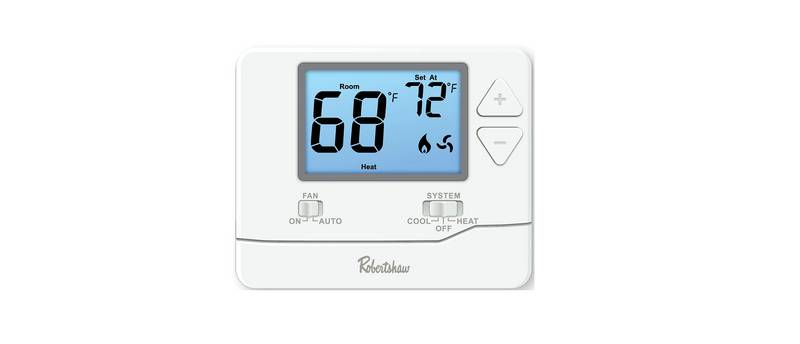
Home > Robertshaw > Robertshaw RS9220 Digital Programmable Wall Thermostat Instruction Manual

Robertshaw RS9220 Digital Programmable Wall Thermostat Instruction Manual

RS9220  
Operation Manual  
GeneralDetails
NameRobertshaw RS9220 Digital Programmable Wall Thermostat Instruction Manual
MakeRobertshaw
LanguageEnglish
FiletypePDF (Download)
File size0.24 MB
Download PDF
1 Star2 Stars3 Stars4 Stars5 Stars (1 votes, average: 5.00 out of 5)
Loading...
Robertshaw RS9220 Programmable Thermostat Installation Guide
Robertshaw RS10420T WIFI Programmable Thermostat User Guide
Robertshaw RS8110 Non Programmable Thermostat Instruction Manual
Robertshaw RS8210 Non-Programmable Multi-Stage 2H-1C Wall Thermostat User Manual
Robertshaw RS8210 Thermostat Installation Guide
Robertshaw 9602 Programmable Thermostat User Manual
Robertshaw RS9320T Programmable Touchscreen Wall Thermostat Instruction Manual
Robertshaw RS9423T Thermostat Installation Guide
Robertshaw RTC500 WIFI Thermostat Instruction Manual
Robertshaw RS1110 Programmable 1 Heat 1 Cool Wall Thermostat Instruction Manual

Robertshaw RS9220 Digital Programmable Wall Thermostat Instruction Manual
Get the free PDF manual for the Robertshaw RS9220 Digital Programmable Wall Thermostat Instruction Manual and access setup steps, usage instructions, and troubleshooting tips. 👉 View online or download now to keep your thermostat running smoothly!
Robertshaw RS9220 Digital Programmable Wall Thermostat Instruction Manual Overview

Summary of Contents

  • Page 1: Operation manual
  • Page 2: Caution Do not switch system to cool if the temperature is below 50°F (10°C). This can damage the air conditioning system and cause personal injury. Thermostat operation Thermostat quick reference Programming Installer setup menu Terminal designations
  • Page 3: - The document appears to relate to the operation of a thermostat. - It includes settings for temperature control. - There are options for different modes such as cool, heat, and off. - The system features an LCD screen for display. - There are user buttons for adjusting settings. - Temperature set-point buttons are available for user input. - A fan switch is included for controlling fan operation. - The document mentions a sleep system feature. - The fan can be set to auto or manual operation. - There is a menu option for additional settings.
  • Page 4: Thermostat operation includes an LCD screen for detailed information. Temperature set-point buttons allow users to press the desired temperature. The fan switch can be set to ON for continuous operation or AUTO to cycle with the HVAC system. User buttons are available for setting up programming options. The system switch selects between HEAT or COOL modes for the HVAC system. Selecting HEAT activates the heating mode, while COOL activates air conditioning. The OFF setting turns off both heating and cooling functions.
  • Page 5: Quick reference displays the user selected set-point temperature, days of the week, and time. Hold is displayed when the thermostat program is overridden. Low battery indicator shows when batteries need to be replaced. System operation indicators display when the cool, heat, or fan is on. If icons are flashing, there is a 5-minute delay for compressor protection. This thermostat has 4 programmable time periods per day. Indicates the current room temperature.
  • Page 6: Caution: When the battery icon appears, replace the alkaline AAA batteries immediately to avoid damage to your HVAC system. Battery door information: Install two AAA alkaline batteries into the battery compartment. Be sure to match positive (+) ends of batteries with positive (+) battery terminals in the battery compartment. Press the lower portion of the thermostat to open the easy access battery door.
  • Page 7: Temperature adjustment can be made if using a program schedule. You may temporarily change the desired temperature set-point by pressing specific buttons. The temperature will remain at this set-point until the next programmed event. The thermostat will display HOLD and RUN SCHED when you press certain buttons. You may hold the temperature at a fixed set-point and override the program schedule. The thermostat will notify you that the program schedule hold is in effect. To return to programming, press RUN SCHED.
  • Page 8: Filter change reminder can be configured to alert when the air filter needs changing. The reminder can be adjusted to up to 2000 hours in 50-hour increments. When the reminder is active, FILTER will be displayed. To reset the filter change reminder, hold down the second button from the top left side for 3 seconds. Change the air filter when FILTER is displayed. The thermostat has various settings including cool, heat, and fan options. The display shows the current room temperature and time. The system can be set to auto mode. The thermostat features a sleep mode. The menu allows for additional settings and adjustments.
  • Page 9: Set time of day and day of week. Press the MENU button. Press SET TIME. Day of the week will be flashing. Use to select the current day of the week. Press NEXT STEP. The current hour will be flashing. Use to select the current hour. Press NEXT STEP. The minutes will be flashing.
  • Page 10: Custom programming This thermostat can be configured to have 7 Day or 5+1+1 programming. If 7 Day is selected, all seven days will need to be programmed individually. If 5+1+1 programming is selected, Monday–Friday will be programmed together and Saturday and Sunday will need to be programmed individually. There are four time periods for each day (WAKE, LEAVE, RETURN, SLEEP). Select HEAT or COOL. Heat and cool need to be programmed separately. Press MENU (If menu does not appear first, press RUN SCHED). Press SET SCHED. Monday–Friday (or Monday if in 7 Day mode) will be displayed and the WAKE icon is shown. Time will be flashing. Use selection for the WAKE time period for Monday–Friday.
  • Page 11: Programming instructions include setting the set-point temperature for different time periods. The set-point temperature will be flashing during selection. Use the appropriate buttons to make your set-point selection for the WAKE time period. This applies for Monday–Friday or Monday if in 7 Day mode. Repeat the process for the LEAVE, RETURN, and SLEEP time periods. Continue with the same steps for Saturday and Sunday time periods. This is applicable for both the 5+1+1 program schedule and the 7-day program schedule. Ensure to follow the sequence of steps for accurate programming. Each time period must be set individually for each day of the week. Press NEXT STEP to proceed through the programming process.
  • Page 12: Installer setup menu Press MENU. Press and hold TECH SET button for 3 seconds. Configure the installer options as desired using the table. Use navigation buttons to move from one option to another. Use buttons to change settings and the NEW STEP. Only press DONE when you want to exit the Installer Setup Options.
  • Page 13: Installer setup menu includes settings for display and adjustment options. The filter change reminder can be adjusted from OFF to 2000 hours in 50-hour increments. Press the second button from the top left side of the thermostat to display the current filter elapsed run time. The setting will flash FILT in the display after the elapsed run time to remind the user to change the filter. The OFF setting will disable the filter change reminder feature. The installer can change the calibration of the room temperature display. The room temperature display can be adjusted to read up to 3° above or below the factory calibrated temperature. The minimum compressor run time can be adjusted from OFF to 3, 4, or 5 minutes. If a time is selected, the compressor will run for at least that time before turning off. The installer can select the minimum run time for the compressor to help protect it from short-cycling.
  • Page 14: Installer setup menu Settings Display Adjustment options The compressor short cycle delay setting will not allow the compressor to be turned on for 5 minutes after it was last turned off in order to protect the compressor. The compressor short cycle delay setting can be removed by selecting OFF. The cooling differential is factory preset at 0.5°. This means that whenever the room temperature heats by 0.5° full degree from the temperature setting, the cooling system will turn on. The cooling differential setting is adjustable from 0.2°F to 2°F. The heating differential is factory preset at 0.4°. This means that whenever the room temperature cools by 0.4° from the temperature setting, the heating system will turn on. The heating differential setting is adjustable from 0.2°F to 2°F.
  • Page 15: Installer setup menu Settings Display Adjustment options Select F for Fahrenheit temperature display or select C for Celsius display. Select a 12 or 24 hour clock setting. Use to select 12 or 24 hour clock. Select GAS or ELEC depending on the type of furnace.
  • Page 16: Installer setup menu includes settings, display, and adjustment options. The thermostat can be configured for 7 Day, 5+1+1 programming, or be non-programmable. If 7 Day is selected, all seven days must be programmed individually. For 5+1+1 programming, Monday to Friday will be programmed together, while Saturday and Sunday need individual programming. Selecting 0d makes the thermostat non-programmable.
  • Page 17: Terminal designations for HVAC systems include various connections for heating and cooling functions. RH is for 24VAC heat, while RC is for 24VAC cool. C represents 24VAC common if applicable. W indicates the first stage of heat, and W2 indicates the second stage of heat. Y denotes the first stage of cool, and Y2 denotes the second stage of cool. G is used for the fan connection. B indicates the heat activated reversing valve, and O indicates the cool activated reversing valve.
  • Page 18: Page 18