
STELPRO STE302NP Programming Electronic Thermostat




USER’S GUIDE
STE302NP
SINGLE PROGRAMMING ELECTRONIC THERMOSTAT
Energy Verified
INSSTE302NP0614
For further information or to consult this guide online, please visit our website at www.stelpro.com


| General | Details |
|---|---|
| Name | STELPRO STE302NP Programming Electronic Thermostat |
| Make | StelPro |
| Language | English |
| Filetype | PDF (Download) |
| File size | 0.36 MB |
 (1 votes, average: 5.00 out of 5)
 Loading...

STELPRO STF362NP Floor Heating Thermostat Owner’s Manual

STELPRO ST302P Programmable Electronic Thermostat Owner’s Manual

STELPRO SAT402ZB Smart Thermostat User Guide

STELPRO ST252NPFF Non-Programmable Electronic Thermostat Owner’s Manual

STELPRO ST402PFF Programmable Electronic Thermostat Owner’s Manual

STELPRO ASMC402 Maestro Zigbee Smart Programmable Thermostat User Guide

STELPRO SIBTE12C Electronic Thermostat Owner’s Manual

STELPRO STZW402+ Electronic Thermostat for The Smart Home Owner’s Manual

STELPRO SIBTE13F Electronic Thermostat User Guide

STELPRO STCP MULTIPLE PROGRAMMING ELECTRONIC THERMOSTAT User Guide

STELPRO STE302NP Programming Electronic Thermostat Overview
Summary of Contents
- Page 1: User's guide for the STE302NP single programming electronic thermostat. Energy verified. Model: INSSTE302NP0614.
- Page 2: Warning Before installing and operating this product, the owner and/or installer must read, understand and follow these instructions and keep them handy for future reference. If these instructions are not followed, the warranty will be considered null and void. The manufacturer deems no further responsibility for this product. All electric connections must be made by a qualified electrician, according to the electric and building codes effective in your region. Do not connect this product to a supply source other than 120 VAC or 240 VAC, and do not exceed the load limits specified. Protect the heating system with the appropriate circuit breaker or fuse. You must regularly clean dirt accumulations on the thermostat. Do not use fluid to clean thermostat air vent. Do not install thermostat in a wet place. The instruction manual may not entirely match all the functions of the actual product.
- Page 3: The electronic thermostat STE302NP can control electric heating units with high accuracy. It is designed for installations with electrical current ranging from 1.25 A to 12.5 A. The thermostat is user-friendly and allows precise temperature control. It is incompatible with electrical currents higher than 12.5 A, lower than 1.25 A, and central heating systems. Supplied parts include one thermostat, a wall mounting plate, two mounting screws, and two solderless connectors. The thermostat should be mounted on a wall facing the heating unit, approximately 1.5 m above the floor. Avoid installing the thermostat near windows, external walls, doors, or heat sources. It should not be placed in areas with poor air flow or frequent drafts.
- Page 4: Thermostat mounting and connection Cut off power supply on lead wires at the electrical panel in order to avoid any risk of electric shock. Ensure that the air vents of the thermostat are clean and clear of any obstruction. Using a screwdriver, loosen the screw retaining the mounting base of the thermostat until you feel a loose. Remove the mounting base at the back of the thermostat by tilting it downward, then towards you. Align and secure the mounting base to the connection box using the two screws supplied.
- Page 5: Pass the wires from the wall through the hole at the base of the mounting base and connect them using the supplied solderless connectors. When making the connection with aluminum wire, ensure that you are using connectors identified CO/ALR. The thermostat wires do not have polarity, so the way they are connected is not important. 2-wire installation 4-wire installation
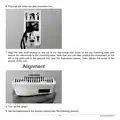
- Page 6: Place all the wires into the connection box. Align the little slots located on the top of the thermostat with those on the mounting base and secure the thermostat to the mounting base. You can also position the thermostat on the left or the right side of the junction box. Tighten the screw at the bottom of the unit. Turn on the power. Set the thermostat to the desired setting.
- Page 7: Operation Ambient temperature Heating power indicator Pictograms Fan mode Frost-free warning Day mode Single programming mode Security mode Initial start up When powering on for the first time, the thermostat is initially set to Day mode displayed in Celsius and is set at 21 degrees by default.
- Page 8: Temperature set points can be displayed in degrees Celsius or Fahrenheit. To adjust the set point, press the top button to increase or the bottom button to decrease the value. Set points can be adjusted by increments of 0.5°C (1°F). The minimum set point is 3°C (37°F), and the maximum set point is 30°C (86°F). In Day mode, you can turn off the thermostat by lowering the set point below 3°C. The thermostat includes a Day mode and a Night mode, each with independently adjustable set points. The standard factory set point for Day mode is 21°C (70°F) and for Night mode is 18°C (64°F). The Night mode features a timer that automatically returns to Day mode after a selectable time period. The standard factory adjustment of the timer is 8 hours. The thermostat will automatically return to Day mode at the end of the night.
- Page 9: Night mode timer adjustment procedure Adjust the Day/Night mode set points at the desired temperatures. From the Night mode, press down the two buttons for more than 3 seconds until the Moon icon blinks. Adjust the timer by pressing down the top button to increase the value, or the bottom button to decrease it. The adjustment range is from 1 hour to 999 hours. Release the buttons and wait for 5 seconds to exit the adjustment function. The Night mode timer will be automatically reinitialized to the latest recorded value when switching from Day mode to Night mode. The Single programming mode allows alternating between the Day/Night modes over a 24-hour period. Once activated, this mode allows an automatic return to the Night mode after 24 hours. The thermostat will operate in the Night mode for the duration of the Night mode timer cycle. The cycle starts with the Night mode as soon as the Single programming mode is activated.
- Page 10: Adjustment procedure of the Single programming mode includes several steps for setting the Day/Night temperatures and adjusting the timer. To switch modes, press and hold two buttons simultaneously and release them immediately. The Night mode timer can be adjusted between 1 hour to 23 hours, and exceeding this limit will deactivate the Single programming mode. Activating the Single programming mode requires pressing the two buttons for at least 3 seconds, and the icon will appear. Manual changes to the Day/Night mode can be made at any time during a 24-hour cycle without needing to readjust the Single programming mode. When powered off, the Single programming mode will deactivate, and the icon will blink upon pressing a button. The thermostat can display temperature in either degrees Celsius or Fahrenheit. To change the temperature display, press the two buttons for 3 seconds, and the Celsius/Fahrenheit symbol will blink. Press the top button to toggle between Celsius and Fahrenheit. The backlit models require holding the buttons for 8 seconds to change the temperature display.
- Page 11: When the adjustment is completed, release the buttons and wait for 5 seconds to exit the adjustment function. The level of power used to maintain the temperature at the set point is expressed as a percentage indicated by the number of bars in the thermometer displayed. The heating power used is displayed as follows: 4 bars = 75% to 100%, 3 bars = 50% to 75%, 2 bars = 25% to 50%, 1 bar = 1% to 25%, 0 bar = no heat. The Snowflake icon is displayed when the temperature set point is between 3°C (37°F) and 5°C (41°F). A minimum temperature will be maintained to ensure frost control. It is possible to impose a maximum temperature set point by activating the Security mode. To activate the Security option, from the Day mode adjust the day set point to the desired maximum temperature. From the Day mode, simultaneously press down the two buttons for more than 13 seconds, until the icon appears. Release the buttons. The thermostat is now locked.
- Page 12: Procedures to deactivate the Security mode involve cutting off the thermostat power at the circuit breaker and waiting at least 20 seconds. After turning the thermostat power back on, the icon will blink for a maximum of 5 minutes. Simultaneously pressing both buttons for 13 seconds will deactivate the Security mode, indicated by the disappearance of the icon. The activation of the Fan mode is similar to the Celsius/Fahrenheit adjustment. To activate or deactivate the Fan mode, press both buttons simultaneously for 3 seconds while in Day mode. When the Fan mode is activated, the stop or minimum heating time for a complete 10-minute cycle is established at 90 seconds. You can adjust the minimum heating time from 90 to 300 seconds to limit the thermostat's on/off cycles. If the thermostat reaches a differential superior or inferior to the requested 2 degrees, it will shut off immediately. The deactivation of the Fan mode will revert the thermostat to the previously programmed heating cycle. Ventilation intervals duration can be adjusted similarly to the fan activation procedure, allowing adjustments from 90 to 300 seconds.
- Page 13: Parameters saving and power failures The thermostat saves some parameters in a non-volatile memory to recover them after being shut off. These parameters include Day/Night settings, Single programming mode, Security mode state, Celsius/Fahrenheit symbol, Fan mode, and heating cycle duration. Parameters are saved every minute if changes are made, except for Day/Night mode and remaining time on the time-switch. The Single programming mode is not automatically reactivated when the thermostat is turned on. The icon blinks to warn the user that the Single programming mode is no longer active. The existing Day/Night mode is recovered only if the Single programming mode was previously deactivated. The Security mode is reactivated if it was previously activated, with a blinking icon for 5 minutes. During the blinking period, the Security mode can be deactivated by pressing both buttons simultaneously for 13 seconds. Night light option can be activated to permanently turn on the backlight. To activate or deactivate the night light mode, the thermostat must be set in Day mode and both buttons pressed simultaneously for 3 seconds.
- Page 14: Troubleshooting In normal operating conditions, the thermostat housing can reach nearly 40°C at maximum load. That is normal and will not affect the effective operation of the thermostat. Check if the thermostat is properly connected. Refer to the installation section. The thermostat is hot. Heating is always on. Heating does not run even if the thermostat indicates it is on. The display does not turn on. Check the power supply at the electrical panel. The thermal protection of the heating unit has opened due to overheating. The load is lower than the minimum load. Install a heating unit that is within the load limits of the thermostat. Faulty thermal sensor. Contact customer service.
- Page 15: Technical specifications Supply voltage: 120/208/240 VAC, 50/60 Hz Minimum electrical current with a resistive load: 1.25 A Maximum electrical current with a resistive load: 12.5 A Temperature display range: 3°C to 40°C (37°F to 99.5°F) Temperature display resolution: 0.5°C (0.5°F) Temperature set point range: 3°C to 30°C (37°F to 86°F) Temperature set point increments: 0.5°C (1°F) Storage temperature: -40°C to 50°C (-104°F to 122°F)
- Page 16: Limited warranty This unit has a 3-year warranty. If at any time during this period the unit becomes defective, it must be returned to its place of purchase with the invoice copy. Contact customer service with an invoice copy in hand. In order for the warranty to be valid, the unit must have been installed and used according to instructions. If the installer or the user modifies the unit, he will be held responsible for any damage resulting from this modification. The warranty is limited to factory repair or replacement of the unit. The warranty does not cover the cost of disconnection, transport, and installation.

namron 4512738 Touch Zigbee 16A Thermostat Instruction Manual

Vine TJ-610E Smart Thermostat User Manual

HVAC Controls UT32 Titan Touchscreen Thermostat User Manual

Sygonix 2992337 DIN Rail Mounted Heating And Cooling Thermostat User Manual

vtech W960 Installing E-Smart Thermostat Instruction Manual

Honeywell RTH230B Programmable Electronic Thermostat User Guide

ideal BOILERS Combi RF Wireless Boiler Thermostat User Guide

GE Lighting SST-W300 Smart Thermostat User Guide

SECURE ThermoPlus AS2 Programmable Room Thermostat Instruction Manual

Vine Smart Wi-Fi Thermostat with Nightlight TJ-225 User Guide