
velleman K2649 Thermostat with LCD Display Instruction Manual


Total solder points: 166 + 116
Difficulty level: beginner 1 ꢀ2 ꢀ3 ꢀ4 ꢁ5 ꢀadvanced
THERMOSTAT WITH LCD-DISPLAY
K2649
Specifications
ꢂ
ꢂ
ꢂ
ꢂ
Adjustable hysteresis: 0,2°C (0,4°F) to 10°C (18°F).
Resolution of the display: 0,1°C or 1°F.
Mains voltage: 110/230VAC
Relay output: 240V, 3A max.
ILLUSTRATED ASSEMBLY MANUAL
H2649IP-1


| General | Details |
|---|---|
| Name | velleman K2649 Thermostat with LCD Display Instruction Manual |
| Make | Velleman |
| Language | English |
| Filetype | PDF (Download) |
| File size | 0.56 MB |
 (1 votes, average: 5.00 out of 5)
 Loading...

velleman VM148 Programmable Thermostat Instruction Manual

velleman K2649 Thermostat with LCD Display Instruction Manual Overview
Summary of Contents
- Page 1: Total solder points: 166 + 116 Difficulty level: beginner to advanced Thermostat with LCD-display Specifications Adjustable hysteresis: 0.2°C (0.4°F) to 10°C (18°F) Resolution of the display: 0.1°C or 1°F Mains voltage: 110/230VAC Relay output: 240V, 3A max Illustrated assembly manual
- Page 2: Page 2
- Page 3: Features & specifications The very precise digital display of both the set and actual temperature makes this thermostat very easy to use. The connecting capability for an 'economy switch' allows the set temperature to be decreased when the contact is closed. No measuring apparatus is needed for adjustments. Thanks to the wide setting range of both the hysteresis and the desired temperature, this kit can be used for various applications beyond regulating room temperature. Wide measuring and regulating range: -50 to +150°C (-60 to +300°). Adjustable hysteresis: 0.2°C (0.4°F) to 10°C (18°F). Resolution of the display: 0.1°C or 1°F. Can be set for degrees Celsius or Fahrenheit. Power supply and transformer included. Relay output: 240V, 3A max.
- Page 4: Assembly hints These hints will help you to make this project successful. Make sure you have the right tools: A good quality soldering iron (25-40W) with a small tip. Thin raisin-core solder. A diagonal cutter to trim excess wires. Needle nose pliers, for bending leads, or to hold components in place. Small blade and Phillips screwdrivers. Make sure the skill level matches your experience, to avoid disappointments. Follow the instructions carefully. Perform the assembly in the correct order as stated in this manual. Use the check-boxes to mark your progress.
- Page 5: Assembly hints Soldering hints: Mount the component against the PCB surface and carefully solder the leads. Make sure the solder joints are cone-shaped and shiny. Trim excess leads as close as possible to the solder joint. Do not blindly follow the order of the components onto the tape. Always check their value on the parts list. Remove them from the tape one at a time.
- Page 6: Power supply mode ‘P2649V’ Diode. Watch the polarity! Zenerdiode. Watch the polarity! IC socket. Watch the position of the notch! Resistors include various values such as 10K, 220K, and 560K. Diodes include types like 1N4148 and 1N4007. Metal film resistors are specified. Components are labeled with specific designations like R1, R2, and D1. CATHODE markings are indicated for certain components. Ensure correct polarity for all diodes and zener diodes.
- Page 7: Construction Terminal blocks Ceramic capacitor Capacitor Transistor Mains “ES” Economy switch Vertical trimmer For heaters use the contacts: ‘C’ & ‘NO’. For coolers use the contacts: ‘C’ & ‘NC’.
- Page 8: Construction Electrolytic capacitor. Watch the polarity! Flat cable Choosing hysteresis If you desire a small hysteresis (adjustable from 0.2 to 1°C or from 0.4 to 4°F), then fit for R24 and R25 a 180K metal film resistor. If you prefer a larger hysteresis (between 1 and 10°C or 2 and 20°F), then fit a wire link for R24 and R25. IC. Watch the position of the notch! Relay
- Page 9: Construction Display module ‘P2649D’ Jumpers Resistors Mount for R13: 1M for °C or 150K for °F. For degrees Celsius, the following resistors must be fitted too. Choose temperature display: JC for °C, JF for °F. IC socket, watch the position of the notch! Metal film resistor R... Mount for R10: 390 for °C or 330 for °F.
- Page 10: Construction Ceramic capacitors LCD display C4: 100nF (104) C6: 100pF (101) Transistor T2: BC557B Attention: For °F this transistor should not be fitted! Horizontal trimmers RV1: 4K7 First look for pin 1: if a colon is displayed when connecting the battery, then you have the display correctly mounted. If only one point is displayed, then you have to turn the display.
- Page 11: Construction Capacitors Pay attention to the position: the upper surface must be at 8mm above the PCB surface. You may put some pieces of paper between the LCD and the PCB to help you hold the display at the right height. LED. Watch the polarity! First solder only the pins at the four corners. Verify the height, and correct if necessary. Then solder the remaining pins. Be very careful, for this part is not cheap!
- Page 12: Construction Push button. Axe. Watch the position of the notch. Insert the plastic spindle in trimmer RV1 as displayed. IC1: ICL7106.
- Page 13: Sensor calibration is performed by alternately adjusting the meter at the freezing and boiling points of water. The sensor first has to be prepared. Do not shorten the connection wires of the sensor unless you are not going to fit it directly onto the PCB in the future. Solder two isolated wires (75 cm or 30“) to the sensor. Make use of a cable of the desired length (max 10m, and preferably screened to avoid interferences) if you are not going to fit the sensor onto the PCB in the future.
- Page 14: Make the connections waterproof with heat-shrinkable tubing. Cut off a piece of shrinking tube with a length equal to 5cm. Slide the shrinking tube over the wires and over the sensor. Heat the shrinking tube using a hair dryer or, better still, using a paint stripper. Take care that everything is well covered. Connect the whole to the place marked with 'R32 SENSOR'. The connection order is unimportant, unless with screened cable: the screen then comes on the side marked with 'SENSOR'. Connect a mains cable to the screw connector J1-MAINS.
- Page 15: Flat cable Attention: The connecting order (with regard to the PCB edge) must be the same as on the power supply module.
- Page 16: Adjustment During assembly, you made your choice for degrees Celsius or degrees Fahrenheit version. The adjusting method is the same for both, only the values on the display are different. The first adjustment is done at the freezing-point. Fill a beaker with ice cubes and plunge the sensor into the melting-water. As long as not all the ice is molten, the temperature of the melting-water is kept at 0°C (32°F). Then adjust with RV2 until the display reads 00.0 (32°F). After zero-adjustment, the sensitivity of the meter has to be adjusted. Plunge the sensor into boiling water, ensuring it does not come too close to the bottom or wall of the kettle. After a few minutes, the sensor temperature has risen to 100°C (212°F). When the sensor has to be replaced for any reason, then you have to readjust completely.
- Page 17: Use the button S1 to display the set temperature. Change the temperature by turning potentiometer RV1 until the desired temperature is shown. With standard resistor values for R2 and R33, the adjusting range is about 5 to 30°C (40 to 85°F). You can modify this range by using different values for R2 and R33. Experiment to find the optimum adjusting range for your application. Solder a 1M trimmer parallel to both R2 and R33. Adjust both trimmers to achieve the optimum range. Replace the trimmers with normal resistors that closely approximate the set value.
- Page 18: Use the economy switch to lower the set temperature by a number of degrees. The hysteresis is the difference between the temperatures at which the output is switched on and off. A smaller hysteresis is desirable for regulating room temperature. A larger hysteresis is preferred for water heaters. You can adjust the hysteresis with RV4. The adjusting range is about 0.2 to 2°C when R24 and R25 are 180K resistors. The adjusting range is 1 to 10°C when wire links are fitted.
- Page 19: The setting of the hysteresis does not depend on the set temperature. Do not set the minimum hysteresis right from the beginning. The regulation is most precise, however, it could happen that the heating gets switched on and off much too fast and too often. This is not too healthy for the heating installation and/or relay, and too much energy is consumed. Start with RV4 in the middle position, and then search for the ideal position for your application. Should the operation of the thermostat get disturbed by the switching of inductive loads, this is due to the sparks produced in the relay. In most cases, this can be remedied by putting a VDR over the contacts. A series connection of a 100 ohm resistor with a 47 or 100nF/400V capacitor can be placed in parallel with the VDR to further reduce the sparks. Refer to Fig. 8.0 for the circuit configuration. Load specifications include a 100 ohm / 0.5W resistor and a VDR (VDR300).
- Page 20: Mounting Spacers and screws are not included.
- Page 21: Mounting The rectangular opening in the power supply module is used as a passage for the wiring to the mains input, the relay output, and the economy switch.
- Page 22: The display module can be mounted above the power supply module using spacers.
- Page 23: Mounting This thermostat exactly fits into the box type B2649. The sensor can be fitted onto the PCB in a way that it passes through the opening in the side of the bottom. This setup allows the sensor to react more quickly and accurately to room temperature. The mounting of the sensor determines the quality of the regulation. In case of panel-mounting, a longer flat cable may be used for easier access to connections. For liquids, the sensor can be attached to the outside of a metal pipe or made waterproof to be submerged. Air is a worse heat conductor, so the sensor's response time can be improved by circulating air around it. In large rooms heated by hot air, placing the sensor in the cold air circulation can enhance its responsiveness. The intake air, which reflects the actual room temperature, helps the sensor warm up quickly as the temperature increases.
- Page 24: PCB layout (Display module)
- Page 25: PCB layout (power module)
- Page 26: Diagram 3.5 digit LCD module 220VAC
- Page 27: Page 27

hansgrohe AXOR CARLTON Thermostat Mixer Instruction Manual

ENGO E55W230WIFI Wi-Fi Thermostat User Guide

GENERAL LIFE Therma 300S Wired Room Thermostat User Manual

namron 16A 2.0 Zigbee Touch Thermostat Instruction Manual

Danfoss TPOne-RF Electronic Programmable Room Thermostat Installation Guide

Beca BHT-8000 Heating Thermostat User Guide

SALUS RT520 Programmable Thermostat User Guide

king K702E-2 SimplStat Electronic Thermostat Instruction Manual
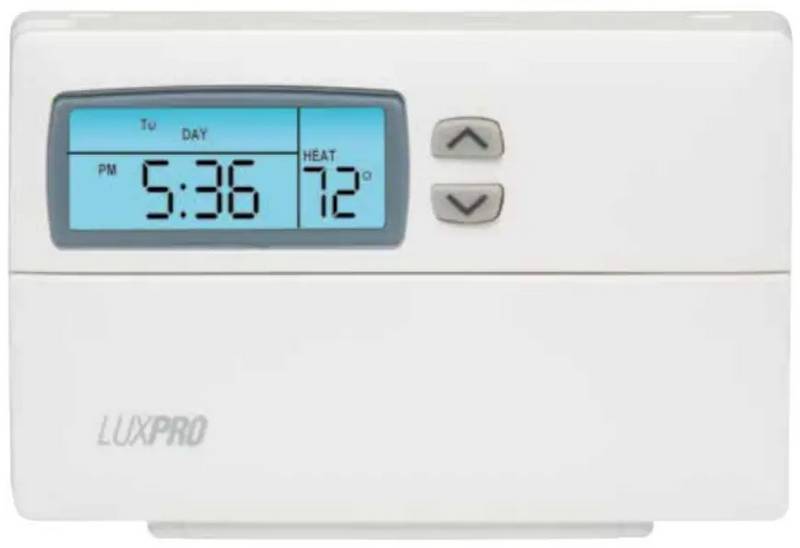
LUX PSP511Ca Programmable Thermostat Instruction Manual

Livn 147 Thermostat User Guide